

South Indian Engagement Ceremony: Rituals, Traditions & Planning Guide
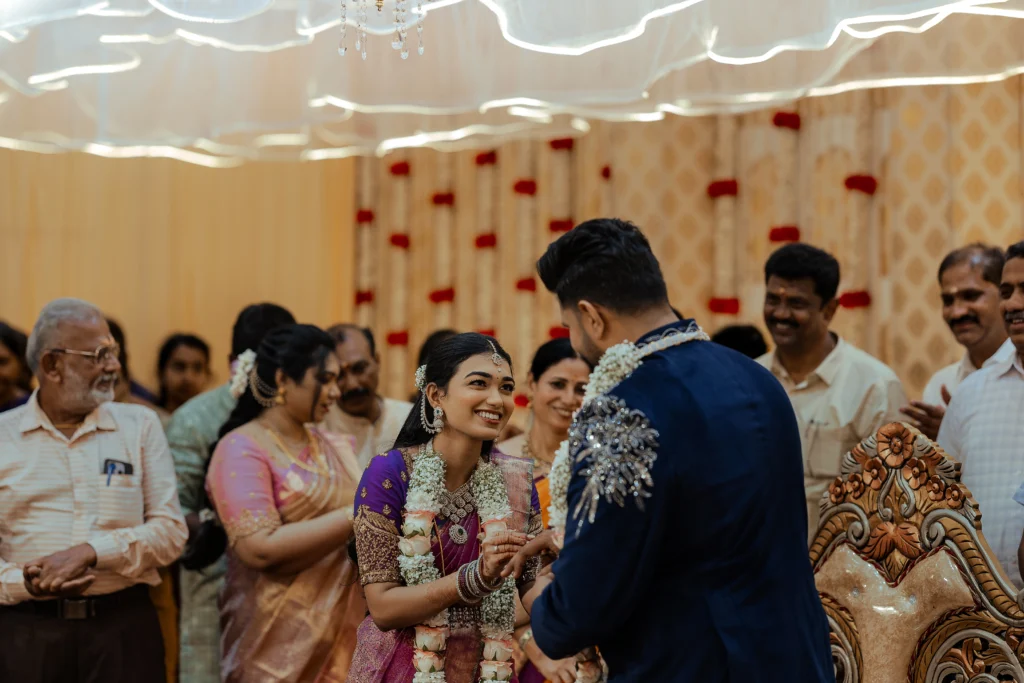
Ask ten South Indian families what their engagement ceremony actually involves and you will get ten slightly different answers — some call it Nischayathartham, some keep it low-key with just immediate family, others treat it as a full function with its own guest list and decor budget. This guide covers what a South Indian engagement ceremony actually involves, the rituals behind it, and how to plan one without getting lost in the regional variations. If you are also planning the photography for your celebrations, explore our South Indian wedding photography.
What Is a South Indian Engagement Ceremony?
The engagement, often called Nischayathartham in Tamil households, is the formal ceremony where both families come together to confirm the wedding — it is less about the couple and more about the two families publicly agreeing to the match. Depending on the family, it can happen weeks or even months before the wedding, or be scheduled close enough that it feels like the start of the wedding week itself.
Unlike haldi or sangeet, the engagement tends to carry more weight ceremonially. There is usually a specific ritual sequence involved, not just a ring exchange and elders play a much bigger role here than in the more casual pre-wedding functions.
The Meaning & Significance of the Engagement Ceremony
At its core, the engagement ceremony is about two families formally agreeing to the marriage, in front of relatives and community, rather than just the couple deciding between themselves. That is part of why it carries more ritual weight than functions like haldi or sangeet — it’s the point where the wedding stops being a private decision and becomes something both families are publicly committed to.
The ring exchange is often what people picture when they think of “engagement,” but in most South Indian ceremonies, it is just one part of a longer sequence that includes blessings from elders, an exchange of gifts between families and sometimes a formal announcement of the wedding date. The ritual elements vary depending on the community, but the underlying purpose stays the same — sealing the commitment before the bigger celebrations begin.
Engagement Rituals Explained
Nischayathartham (Tamil Tradition)
In Tamil households, the engagement is formally known as Nischayathartham, and it typically follows a set sequence — the groom’s family arrives with gifts, there’s an exchange of coconuts and betel leaves between both families, and the bride’s father formally agrees to the marriage in front of both sides. The ring exchange usually comes toward the end, after the families have completed the more traditional parts of the ritual. Priests are often present to read out the wedding date and time, which gets formally announced to both families as part of the ceremony.
Telugu & Kannada Engagement Rituals
Telugu families often refer to this as Nischitartham, with a similar structure but its own regional touches — an exchange of fruits and gifts between families, blessings from elders, and sometimes a short pooja before the rings are exchanged. Kannada households follow a comparable sequence, though the specific items exchanged and the order of rituals can vary from family to family within the same community. What stays consistent across both is the emphasis on the two families formally coming together, not just the couple.
The Ring Exchange & Its Place in the Ceremony
The ring exchange itself is usually a smaller, quieter moment within the larger ceremony rather than the main event — which surprises people expecting it to be the centerpiece the way it might be in a Western-style engagement. It typically happens after the families have completed the gift exchange and blessings, sometimes announced by an elder or priest rather than treated as a standalone moment. Photographically, it is still one of the most requested shots of the day, even if ritually it is just one part of a longer sequence.
For ideas on how these moments can be photographed, explore our engagement photography guide.
How to Plan an Engagement Ceremony: Step-by-Step
Choosing a Date and Time
Most families work with a priest to fix an auspicious date and time for the ceremony, often months ahead of the wedding itself. Unlike haldi, which almost always happens in the morning, engagement ceremonies can be scheduled for morning or evening depending on what the priest recommends and what works for both families’ travel and availability.
Guest List — Who's Typically Invited
Engagement guest lists tend to sit between the intimacy of haldi and the scale of the wedding itself — usually close family from both sides, along with a wider circle of relatives and close family friends. Some families keep it deliberately small and private, especially if the wedding itself is still months away, while others treat it as a proper function worth inviting a larger crowd to.
Venue Ideas
A home setting works well for smaller, more traditional engagement ceremonies, especially since much of the ritual involves seated family groups rather than large open spaces. For bigger guest lists, a banquet hall or small event space gives more room for seating, catering, and decor without things feeling cramped. Outdoor venues work too, particularly for evening ceremonies where the lighting and weather cooperate.
Budget Considerations
Engagement ceremonies can range widely in cost depending on scale — a home ceremony with close family costs a fraction of a venue-hosted one with a larger guest list and full catering. Since the ritual itself doesn’t require elaborate decor to feel complete, this is a function where spending tends to scale with guest count more than with the ceremony’s actual requirements.
Engagement Decor Ideas
Engagement decor tends to be a bit more formal than haldi’s marigold-and-turmeric palette, often leaning into whites, golds and pastels rather than bright yellow. A decorated stage or seating area for the couple and both families is usually the focal point, dressed with flowers and drapes rather than anything too elaborate. For evening ceremonies, string lights and softer lighting tend to work better than the bright, natural-light setups that suit haldi.
What to Wear for the Engagement
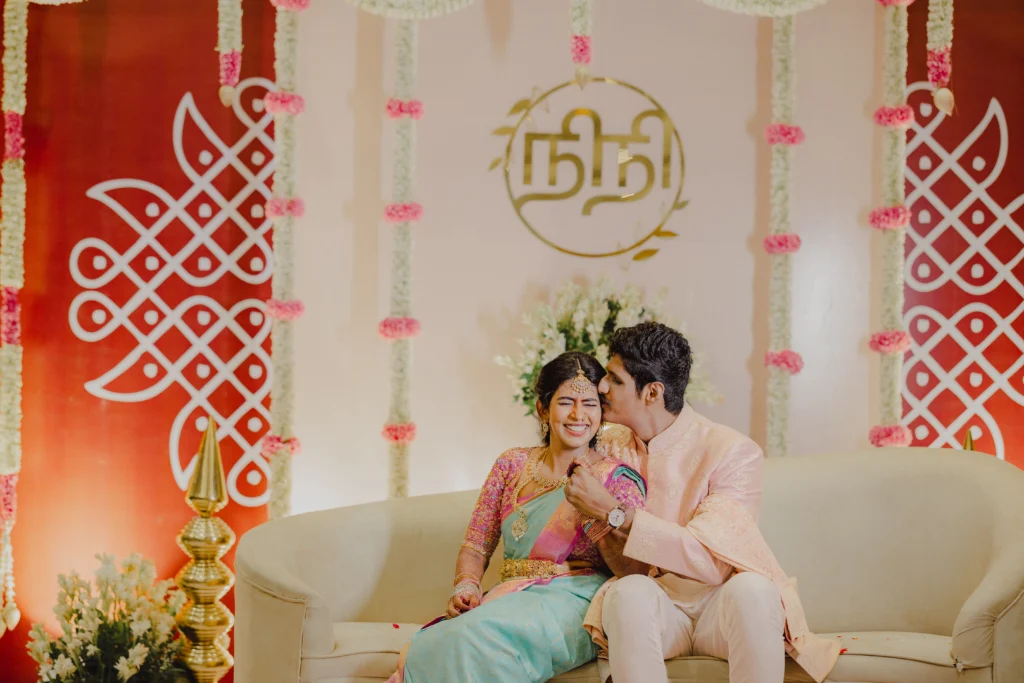
The engagement calls for something a step more formal than haldi or sangeet — think traditional silk sarees or lehengas for the bride, and a kurta or a more formal ensemble for the groom, though styles vary depending on how big the ceremony is. Since there’s no turmeric or paste involved here, outfits can be more elaborate without worrying about stains, which is part of why this is often the function where families bring out heirloom jewelry and finer fabrics.
Capturing the Engagement Ceremony
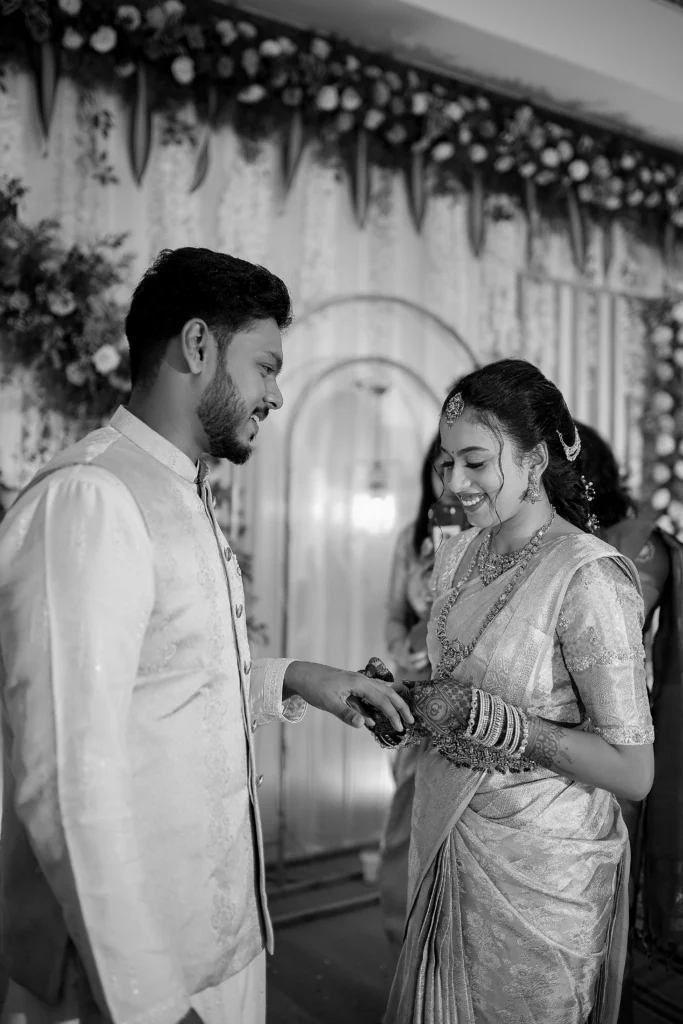
Unlike haldi, which thrives on chaos and candid reactions, the engagement ceremony calls for a different kind of attention — it is more structured, more ritual-driven and a lot of what happens matters because of its sequence, not its spontaneity. The ring exchange, the gift exchange between families, the moment an elder announces the wedding date — these are the shots worth planning for in advance rather than hoping to catch by chance.
That said, there is still plenty of room for genuine moments — a father’s expression as he formally agrees to the match, a mother’s reaction during the ring exchange, both families meeting for what might be the first real celebration together. Getting both the structured shots and the quieter, unplanned ones is what makes an engagement gallery feel complete rather than just procedural.
Final Thoughts
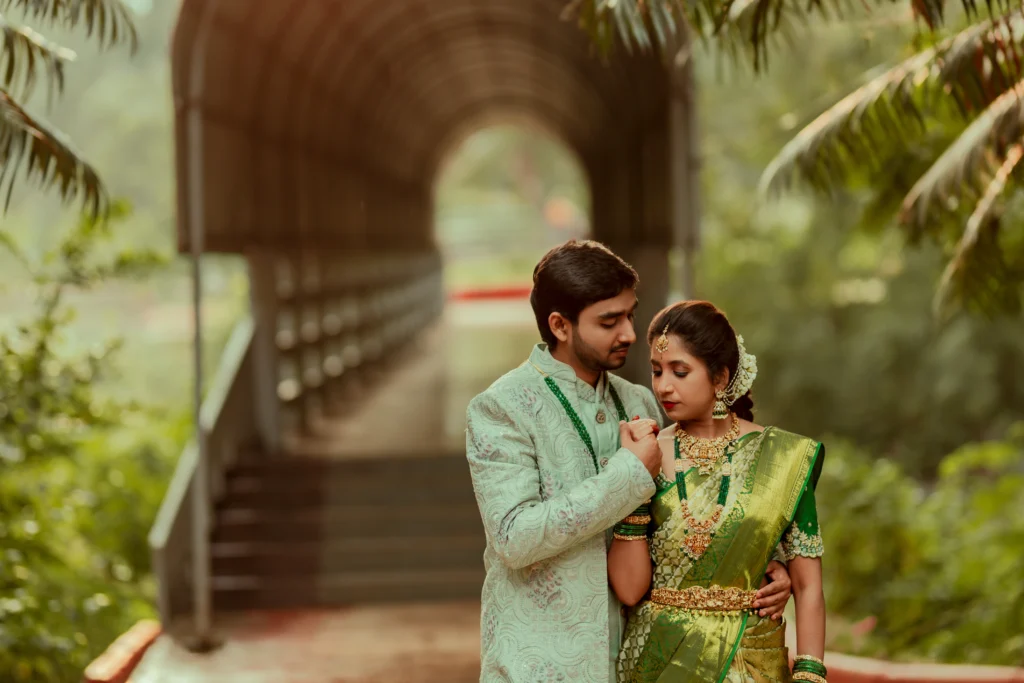
A South Indian engagement ceremony carries more ritual weight than most other pre-wedding functions, but that doesn’t mean it needs to feel stiff or overly formal. Once you understand the sequence — the family rituals, the gift exchange, the ring ceremony tucked in toward the end — planning around it becomes a lot more straightforward.